FSL Blog · 23 Sept 2026
To VC or not to VC?
Some research numbers to get what's best for you and your business.
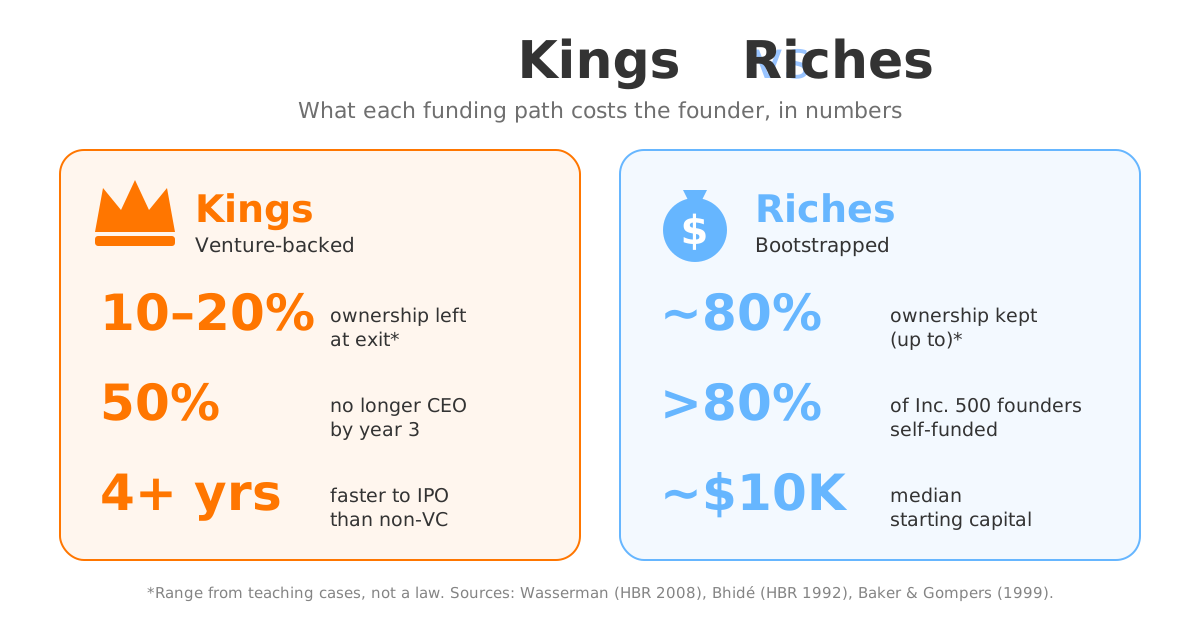
Kings (VCs) vs Riches (Bootstrapped)
Most advice on X and LinkedIn is extremely biased on both ends: bootstrapped founders sharing pictures from their villas not-so-humble bragging about keeping 90% of their profit in pocket and how VCs just stole money in their previous startup.
And you have also the hyperscalers squeezing millions (lately even billions) out of VCs at really favorable terms (>15x ARR) that allows for that take-it-all mentality.
Another angle is a moral preference: bootstrap equals virtuous, VC equals ambitious.
Bootstrapping and venture capital are different machines, optimized for different outcomes, and they charge different prices.
So the useful question is not “which is better?” It is: better for what? or even better for whom?
The outcome in one line
- Choose bootstrapping if you care most about control, early profitability, and staying the main decision-maker.
- Choose VC if you care most about speed, scale, and a faster path to a large exit — and you accept less ownership and less authority.
- Choose a hybrid (lean first, raise later) if you want proof and leverage before you sell control.
Control has a price tag
Noam Wasserman’s Strategic Management Journal study of 6,130 U.S. startups (2017):
- Each extra level of founder control (still CEO and/or board control) is associated with 17.1% to 22.0% lower pre-money valuation.
- The trade-off is especially strong once the company is 3+ years old.
In that sample’s snapshot:
- A founder was still CEO in 49% of companies.
- Insiders controlled more than half the board in 21%.
- Founders still owned more than half the equity in 41%.
Investor type matters: a last round that includes VCs means founders keep less control; a last round that includes angels means founders keep more control.
“Still CEO” is not the long-run default
From Wasserman’s Founder’s Dilemma research (HBR, 2008):
- By year three, 50% of founders were no longer CEO.
- In his succession work, four out of five founder-CEOs were eventually replaced.
- When a professional CEO came in: 37% of founder-CEOs left; 23% moved below the CEO.
Early cash is not the founder fantasy either. In 528 new ventures (1996–2002), 51% of entrepreneurs made the same or less cash compensation than comparable non-founders; and about 20% less after counting equity value.
But this structure (HR, legal, CEO replacement) also allows VC-backed companies to reached IPO more than four years sooner than non-VC-backed
Founder scorecard is not company scorecard
Florin (Journal of Business Venturing, 2005): founders who used VC before IPO generated significantly less personal wealth and were less likely to remain CEO after the IPO than non-VC-backed founders.
If your primary goals are wealth or control, minimize unnecessary VC.
Failure timing (handle carefully)
Via Ghosh / Gage (WSJ, 2012):
- About 75% of VC-funded U.S. startups fail.
- Non-VC startups fail more often in the first four years.
- VC-backed startups more often fail after year four, when capital stops.
Teaching cases sometimes say VC paths leave founders with 10–20% ownership while bootstrappers keep up to ~80%.
Bhidé cites Venture Economics: roughly 7% of VC investments account for more than 60% of the returns. So imagine 100 startups. You are investing $1 in each.
My anecdotal experience and final judgement
In my startup journey I met all 4 founders:
- The bootstrapper who left the wheel of the company while retaining shares and control, cashing $15M a year with barely 2h work a week.
- The VC-backed founder who was able to take >20% of the global market in their niche and are on the path to become billionaires (on paper)
- The bootstrapper who didn't want to lose control and ended up cornered in a lifestyle business while their competitor catched up and eat the market. Leaving not even PE interested in acquisitions above 2x ARR.
- The VC-backed founder who lost their CEO position and was pushed out of the company after 2y. With their cash compensation being tied to IPO or acquisition (so they are basically unemployed)
Do bootstrap when autonomy, margin discipline, and founder control are the point.
Do VC when speed, scale, and institutional growth are the point and you are willing to pay in equity and authority.
Evidence
- Bhidé, A. (1992). Bootstrap Finance. HBR.
- Wasserman, N. (2008). The Founder’s Dilemma. HBR.
- Wasserman, N. (2017). The throne vs. the kingdom. SMJ.
- Baker & Gompers (1999), cited in Wasserman (2017).
- Hellmann, T. & Puri, M. (2002).
- Florin, J. (2005). JBV.
- Ghosh via Gage, WSJ (2012).