FSL Blog · 1 Oct 2026
Sell or keep going? What exit data says
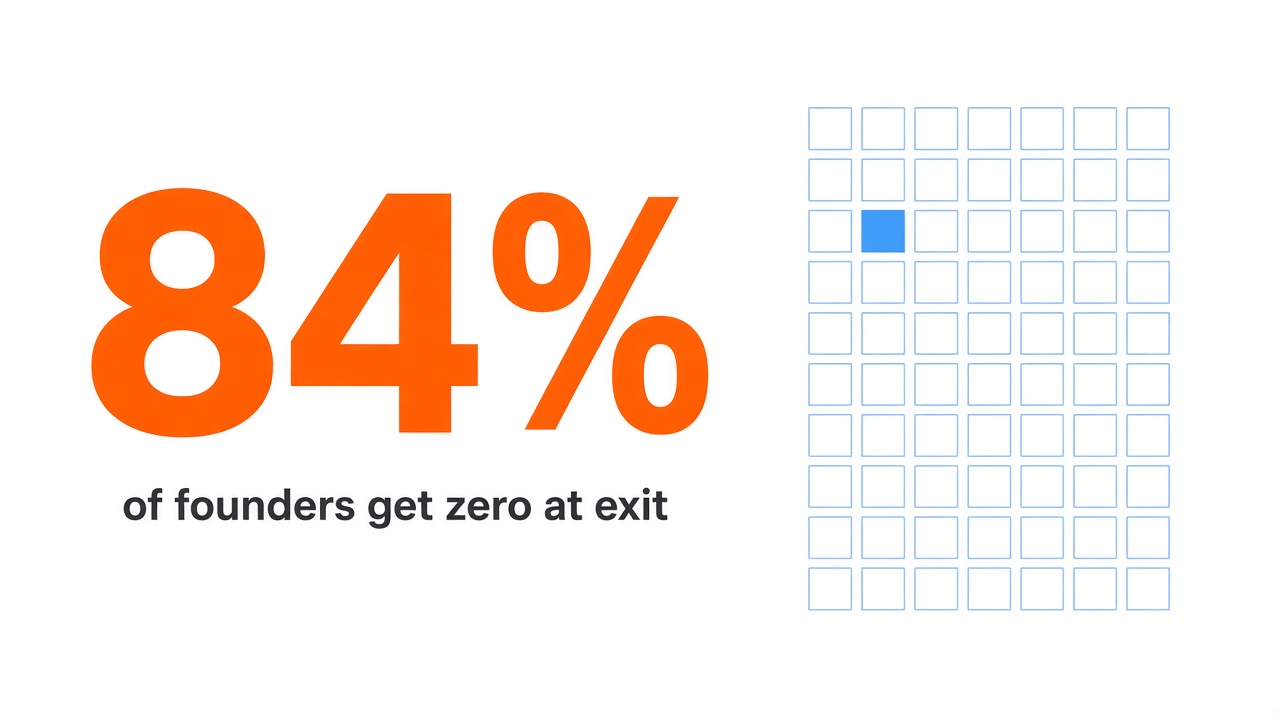
26% of VC-backed startups exit within 10 years, 82% of VC exits are acquisitions and 84% of founders get zero. The data on selling vs persevering.
Sell or keep going? What exit data says
I read a few papers about exits as my LinkedIn and X feed was terribly biased. The papers go through: how often startups exit at all, how they exit, what founders take home, and what happens to founders who keep going or walk away. If an acquisition offer is on your table, you should read this!
Let's start by saying...
Exits are rare and slow
- Balsmeier, Fleming, Marx and Shin: of 27,619 US venture-backed startups, 26% reached an acquisition or IPO within 10 years of founding, with a median return of 203% on invested capital.
- Garfinkel, Mayer, Strebulaev and Yimfor, in a large US PitchBook sample: a 6% IPO rate and a 26% M&A rate, counting only acquisitions at 2x or more of total invested capital.
- Ross, Das, Sciro and Raza on all of Crunchbase: of 942,605 companies, 18,419 were public, 94,225 acquired, 33,298 closed and 796,663 still private.
- Kisseleva, Mjøs and Robinson, on every new firm in Norway: among VC-backed firms with high innovation potential, 2.6% went public, 17.2% were acquired and 7.4% merged. For all high-potential firms, 8.7% were acquired and 3.5% merged.
On timing, Ouyang, Yu and Jagannathan followed 17,242 US ventures: exits came on average six years after the first funding round, and more than 10% of successful ventures took longer than 10 years. Janeway, Nanda and Rhodes-Kropf note that VC funds typically have a ten-year life and successful exits usually come seven to ten years after investment.
Most exits are sales, and sales pay less
Acquisitions made up 82% of US VC-backed exits in 2016 (NVCA data cited by Arora, Fosfuri and Rønde).
Montanaro, Cavallo, Giudici and Ghezzi studied 107 European VC-backed tech exits from 2010 to 2017. Exiting through an IPO and retaining a larger equity stake were both associated with a higher exit value. The literature they cite puts numbers on the gap:
- Founders of private firms receive on average 78% of the payoff of a comparable IPO when they sell.
- Acquisitions of private companies are priced at a 15% to 30% discount to IPOs, despite small differences in pre-deal performance.
On when to sell, Arora, Fosfuri and Rønde built an analytical model (theory, untested on data here): more capable founding teams commit to a late sale, less capable teams commit to an early sale, and teams in between look for early offers and end up selling late.
What founders take home
- Azevedo, Scheuer, Smetters and Yang, on US venture deal data: 84% of founders received zero exit value, and the top 2% captured 80% of total value.
- Isen, Richmond, Smith and Yannelis linked US private equity buyouts to tax data. Owners realised net capital gains on the order of several million dollars in the buyout year, then showed a persistent 30 percentage point drop in employment, larger for owners aged 45 and over. They showed little sign of starting new firms afterwards, and their business income declined persistently.
- Staying on can raise the price. Xie found that when private firms exit by merger, deals where founders remain afterwards command higher returns and benefit acquirers more than deals retaining family successors or hired CEOs, with the largest effect when a founder-CEO stays. The effect is larger for VC-backed and high-tech targets and in deals with earnouts or stock-for-stock payment.
- Seitz and Lehmann looked at 454 founders from 241 startups acquired by Google and Meta: a single founder was harder to retain than a whole cofounder team, and keeping the original cofounder hierarchy helped retention.
Keeping going: what predicts it and what clouds it
- Early sales. Gimmon and Levie followed 142 Israeli incubator ventures for 20 years. Those with sales in each of their earliest years had about a 90% lower hazard of closure over 20 years than those with no early sales.
- Where nascent ventures land. Bergmann and Rychener tracked 135 nascent entrepreneurs without regular sales. One year later 43% had reached regular sales, 33% were still active without them and 24% had abandoned. Founders with a strong mission identity showed signs of escalating commitment to ventures that were not progressing.
- Sunk costs. In three choice experiments with 461 Australian and UK entrepreneurs, Lin and colleagues found that founders who saw themselves as highly rational, and those with a high need for closure, weighted past factors such as sunk personal investment more, and future prospects less, when deciding whether to persist with an underperforming venture.
The cost of walking away to a job
About 50% of people who become entrepreneurs later switch back to paid employment, and Belgian data shows a persistent wage penalty of about 27% on return, around 60% of it explained by former founders valuing independence and flexibility (both cited by Braunerhjelm and Lappi). In Swedish register data, Lappi, Eklund and Klæsson found a persistent earnings penalty for highly educated former founders returning to wage work, and little or none for those with lower education.
What I'd do with this?
If I had a real offer, I'd benchmark it against that distribution, the 15% to 30% acquisition discount and the six-year average wait to exit.
If you sell, offer to stay and bring the team. Founder retention raised deal returns in Xie's data, and acquirers kept whole teams more easily than lone founders.
If you keep going, ignore the sunk-cost fallacy (so, how much you have already put in), because evidence shows that is exactly what founders like you overweight.
Evidence
- Balsmeier, B., Fleming, L., Marx, M., & Shin, S. R. (2020). Startups, Unicorns, and the Local Inflow of Inventors. NBER Working Paper. doi.org/10.3386/w27605
- Garfinkel, J. A., Mayer, E. J., Strebulaev, I. A., & Yimfor, E. (2025). Alumni Networks in Venture Capital Financing. Journal of Financial and Quantitative Analysis. doi.org/10.1017/s0022109025102354
- Ross, G., Das, S. R., Sciro, D., & Raza, H. (2021). CapitalVX: A machine learning model for startup selection and exit prediction. The Journal of Finance and Data Science. doi.org/10.1016/j.jfds.2021.04.001
- Kisseleva, K., Mjøs, A., & Robinson, D. T. (2025). Evaluating Selection Bias in Early-Stage Investment Returns. Journal of Financial and Quantitative Analysis. doi.org/10.1017/s0022109025101701
- Ouyang, S., Yu, J., & Jagannathan, R. (2020). Return to Venture Capital in the Aggregate. NBER Working Paper. doi.org/10.3386/w27690
- Janeway, W. H., Nanda, R., & Rhodes-Kropf, M. (2021). Venture Capital Booms and Start-Up Financing. Annual Review of Financial Economics. doi.org/10.1146/annurev-financial-010621-115801
- Arora, A., Fosfuri, A., & Rønde, T. (2020). Waiting for the Payday? The Market for Startups and the Timing of Entrepreneurial Exit. Management Science. doi.org/10.1287/mnsc.2020.3627
- Montanaro, B., Cavallo, A. F., Giudici, G., & Ghezzi, A. (2021). Determinants of the exit value in European venture capital-backed technology startups. Competitiveness Review. doi.org/10.1108/cr-03-2021-0032
- Azevedo, E. M., Scheuer, F., Smetters, K., & Yang, M. (2025). Dilution vs. risk taking: capital gains taxes and entrepreneurship. Working paper, University of Zurich. doi.org/10.5167/uzh-291824
- Isen, A., Richmond, J., Smith, M., & Yannelis, C. (2025). Buyouts with Payouts: The Impacts of Private Equity on Workers and Owners. Working paper, University of Cambridge. doi.org/10.17863/cam.129376
- Xie, Y. (2023). Founder premiums, venture capital investments and acquirer benefits. Journal of Business Finance & Accounting. doi.org/10.1111/jbfa.12737
- Seitz, N., & Lehmann, E. E. (2025). Does acqui-hiring pay off? An empirical investigation of founder retention. Small Business Economics. doi.org/10.1007/s11187-025-01107-1
- Gimmon, E., & Levie, J. (2020). Early Indicators of Very Long-Term Venture Performance: A 20-Year Panel Study. Academy of Management Discoveries. doi.org/10.5465/amd.2019.0056
- Bergmann, H. C., & Rychener, M. (2026). How do mission-driven ventures emerge? An investigation of startup activities and the achievement of regular sales among early-stage everyday entrepreneurs. Small Business Economics. doi.org/10.1007/s11187-025-01157-5
- Lin, N., Wilden, R., Chirico, F., Ghasrodashti, E., & DeTienne, D. R. (2022). Persist or let it go: Do rational entrepreneurs make decisions rationally? Journal of Business Venturing. doi.org/10.1016/j.jbusvent.2022.106210
- Braunerhjelm, P., & Lappi, E. (2022). Employees' entrepreneurial human capital and firm performance. Research Policy. doi.org/10.1016/j.respol.2022.104703
- Lappi, E., Eklund, J. E., & Klæsson, J. (2022). Does education matter for the earnings of former entrepreneurs? Longitudinal evidence using entry and exit dynamics. Journal of Evolutionary Economics. doi.org/10.1007/s00191-022-00770-x