FSL Blog · 30 Sept 2026
Your odds of raising VC, in numbers
Under 1% of new firms get VC. One seed fund screened 8,000+ startups to invest in 114, and 60% of those it passed on still raised $1M+ elsewhere.
Most founders plan a raise without knowing the base rate, which I digged from 6 scientific papers: how many new firms get venture capital, how many deals a fund screens per check, how much a single rejection tells you, and what investors actually select on.
The base rate is under 1%
- Janeway, Nanda and Rhodes-Kropf's review cites Puri and Zarutskie (2012): fewer than 0.5% of US firms founded each year receive venture capital, yet VC-backed firms make up nearly half of US IPOs.
- Kisseleva, Mjøs and Robinson used administrative data on every new firm in Norway. Of 124,348 new firms, 928 (0.75%) were backed by a professional VC.
- In the same data, firms with high innovation potential were 41.2% of new firms and took 87% of all equity invested in new businesses. About 60% of them never raised equity beyond the legal minimum needed to start.
- Once in, the money compounds: 94% of VC-backed high-potential firms raised equity, averaging 4 rounds, against 38% of all high-potential firms averaging 1.6 rounds.
One fund, 8,000 startups, 114 checks
Jang and Kaplan got the full deal flow of one early-stage VC in the US Midwest from 2015 to 2021:
- It sourced more than 8,000 startups, covering 34% of all Midwest startups that raised seed VC.
- It scored 366 in depth and invested in 114, which is 31% of those scored.
- VCs surveyed by Gompers and colleagues (2020) say they look at about 100 deals for every investment they close.
A pass from one fund says little
In the same data, about 30% of all sourced startups went on to raise at least $1 million in VC from someone, and about 10% raised at least $10 million.
Of the startups the fund analysed in depth and passed on, 60% later raised at least $1 million and 15% raised at least $10 million. Of those it invested in, 32% passed $10 million and 13% passed $25 million. The startups the fund backed did better than the ones it passed on, and the authors still describe the screening as very noisy.
What investors select on
The team, for the first check. In the Gompers et al. survey (cited by Esen, Dahl and Sorenson), nearly half of VC partners named the founders as the most important factor. Product got 13%, business model 10%, market 8%, industry 6%.
Market and product, for the big rounds. In Jang and Kaplan's scoring data, the team score predicted raising at least $1 million and nothing larger. Market and product scores predicted raising $10 million, $25 million and $50 million, and long-term outcomes. The authors read this as VCs overweighting the team.
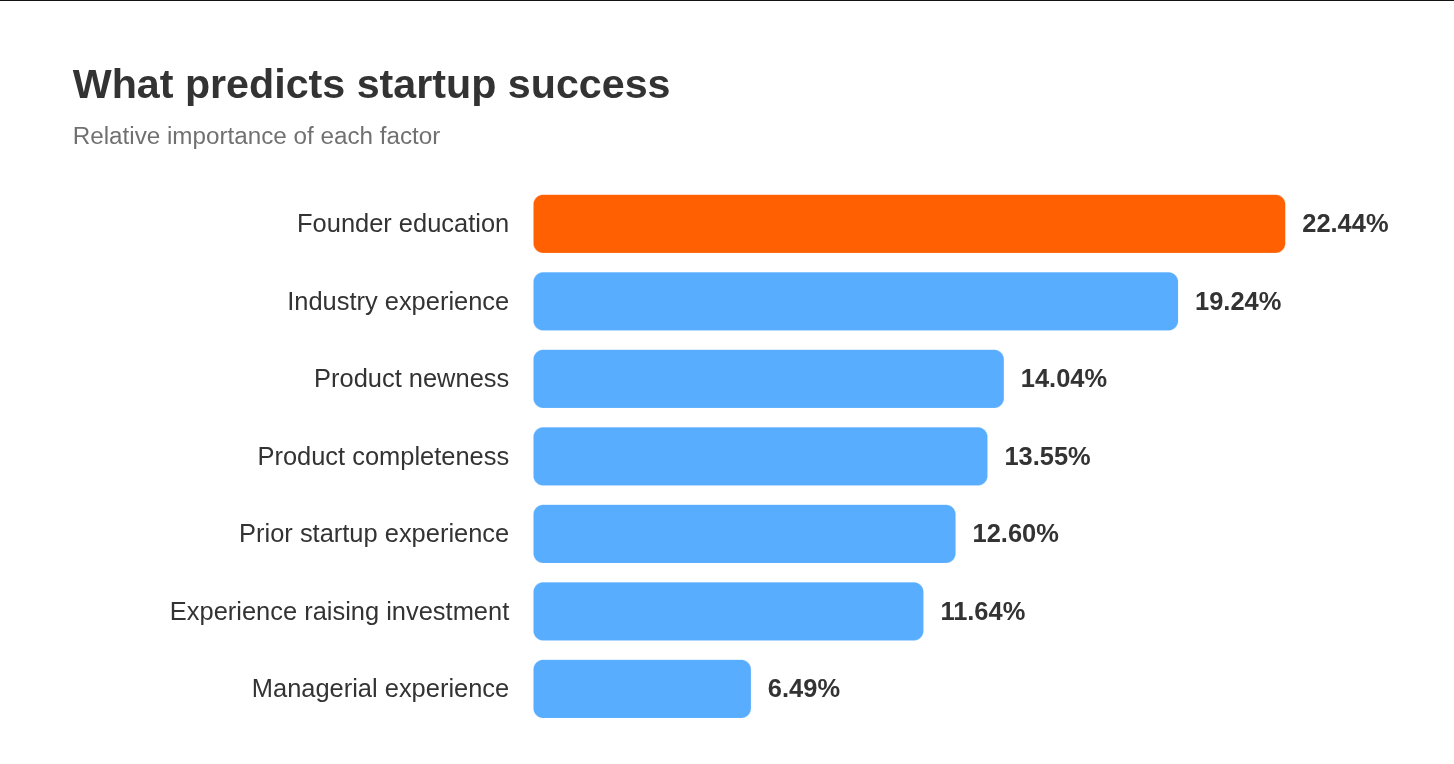
What VCs say they weigh. Kim and Lee ran a conjoint experiment with 263 South Korean VCs. Relative importance of each criterion:
- Founder education: 22.44%
- Industry experience: 19.24%
- Product newness: 14.04%
- Product completeness: 13.55%
- Prior startup experience: 12.60%
- Experience raising investment: 11.64%
- Managerial experience: 6.49% (this was more important in early stage)
Your employees count more than you. Esen, Dahl and Sorenson matched 244 Danish VC-backed startups to 1,220 similar unfunded ones (1995 to 2016):
- Attributes of non-founder employees explained more than 30% of the probability of getting VC, against just over 20% for the founding team.
- One standard deviation more employees meant a roughly 15 percentage point higher chance of VC. Funded startups had more than twice as many employees as their matched peers.
- One standard deviation more education in the founding team meant a nearly 11 point higher chance, and funded teams had earned about 16% more in their previous jobs.
- More industry experience and more small-firm experience among founders and employees were linked to a lower chance of VC in this Danish sample.
- Nearly three quarters of the funded startups had a solo founder, and 42.6% got their first VC within their first year.
Speed. Te and colleagues predicted which startups reach a Series A with an AUC of 84% by combining Crunchbase with founders' LinkedIn profiles. The strongest predictors: days from founding to first funding, number of founders, having a top 10% investor, and founders with prior startup experience.
What I'd do with this
Run the raise as a funnel. At about 100 looks per investment, ten meetings is a sample size of nothing. I'd plan for many more conversations than feels reasonable and read a single pass as noise, since 60% of the startups one fund passed on raised elsewhere.
The team story gets you the first small check. The evidence for the big rounds is market and product, so that is where I'd put the pitch time from seed onwards.
Hire before you raise if you can. In the Danish data, who works for you mattered more for getting funded than who founded the company.
And plan the company for the more than 99% case. Most new firms never take VC, and I wrote about that in Founders, you don't need to raise.
Evidence
- Janeway, W. H., Nanda, R., & Rhodes-Kropf, M. (2021). Venture Capital Booms and Start-Up Financing. Annual Review of Financial Economics. doi.org/10.1146/annurev-financial-010621-115801
- Kisseleva, K., Mjøs, A., & Robinson, D. T. (2025). Evaluating Selection Bias in Early-Stage Investment Returns. Journal of Financial and Quantitative Analysis. doi.org/10.1017/s0022109025101701
- Jang, Y. S., & Kaplan, S. (2025). Venture Capital Start-up Selection. NBER Working Paper. doi.org/10.3386/w33483
- Esen, T., Dahl, M. S., & Sorenson, O. (2023). Jockeys, horses or teams? The selection of startups by venture capitalists. Journal of Business Venturing Insights. doi.org/10.1016/j.jbvi.2023.e00383
- Kim, D., & Lee, S. Y. (2022). When venture capitalists are attracted by the experienced. Journal of Innovation and Entrepreneurship. doi.org/10.1186/s13731-022-00227-2
- Te, Y.-F., Wieland, M., Frey, M., Pyatigorskaya, A., Schiffer, P., & Gräbner, H. (2023). Making it into a successful series A funding: An analysis of Crunchbase and LinkedIn data. The Journal of Finance and Data Science. doi.org/10.1016/j.jfds.2023.100099